













ACCELERATE DESIGN TO KEEP PACE WITH TRANSPORTATION INDUSTRY TRENDS WITH MODSIM
Consumers are increasingly seeking smart, connected, and automated products. Factors such as electrification, cost efficiency, and—most importantly—environmental friendliness are becoming key criteria in product development. Automotive OEMs (Original Equipment Manufacturers) are racing to meet these demands while simultaneously shortening product development cycles.
In addition, a new milestone has emerged in the automotive industry. Traditional manufacturing methods used for internal combustion engine (ICE) vehicles are giving way to new design possibilities enabled by electric vehicles (EVs). Organizations must ensure that these new vehicles comply with increasingly stringent global and local regulatory requirements for sustainability and performance.
Simulation technologies allow manufacturers to evaluate virtual vehicle prototypes under real-world conditions, rather than building hundreds of physical versions for performance and crash testing. However, with traditional tools, creating a simulation-ready model can often take longer than building a physical vehicle for real-world testing.
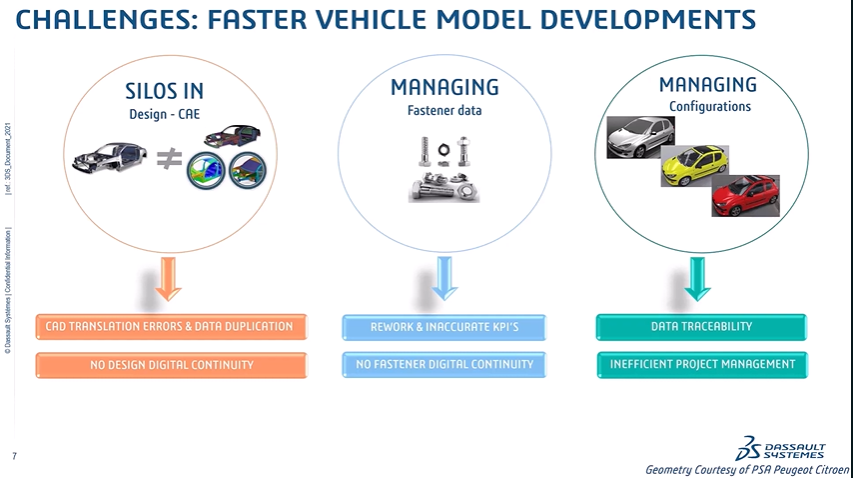
This presents a major challenge for manufacturing enterprises: continuously optimizing production processes to bring products to market that satisfy customers while remaining efficient and manageable for internal operations.
While optimization is essential, traditional manufacturing processes—although well-structured—still suffer from significant limitations, particularly in data-sharing workflows.
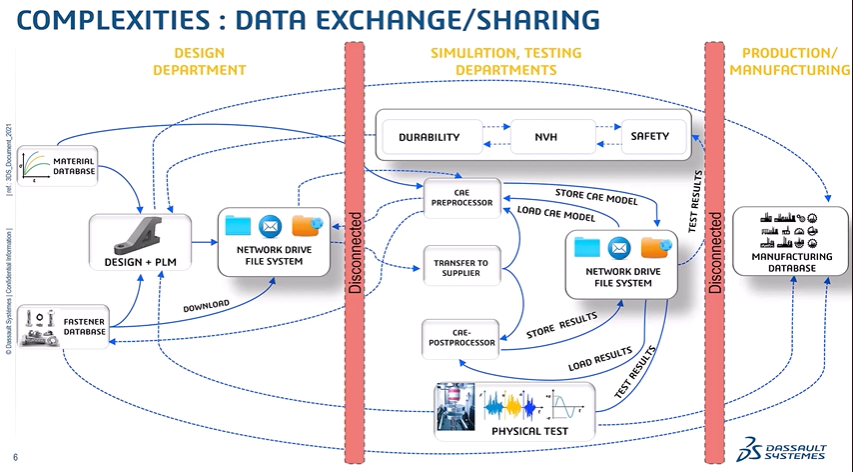
What makes data sharing so complex in traditional enterprises?
Today, most OEMs still operate in fragmented environments, with limited integration between design and simulation departments. As a result, data such as design models, material information, and other critical assets are often shared via email or common file-based systems. This increases the risk of data disconnection and lack of traceability.
Such fragmentation not only slows down design validation but also introduces greater risks throughout the product development lifecycle.
The MODSIM Approach
To address these challenges, the MODSIM approach was introduced, creating a connected environment that brings together both tools and people. MODSIM enables faster and more effective collaboration across departments, ensuring alignment between design and simulation workflows. As a result, it shortens development cycles and improves overall product quality.
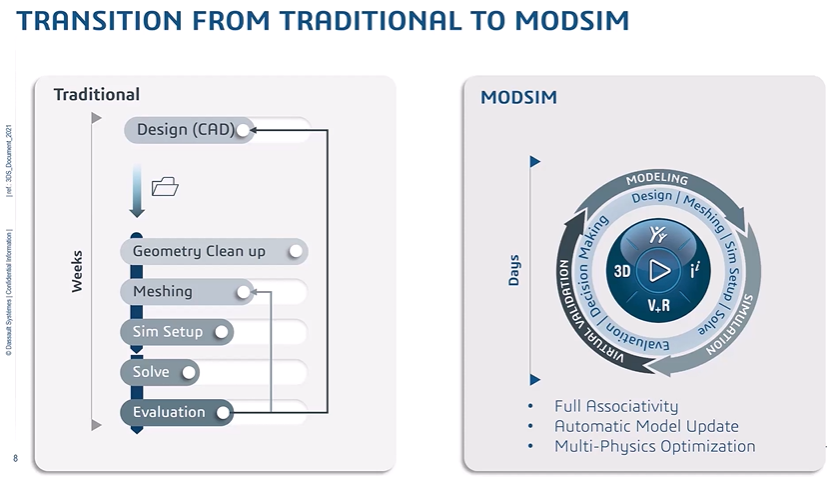
Unlike traditional workflows, MODSIM allows all team members to view or participate in the design process (based on assigned permissions). This significantly reduces wasted time across teams.
For simulation engineers, MODSIM enables real-time visibility into the design process, allowing immediate intervention when issues are identified—without waiting for multiple email exchanges or sequential review steps. MODSIM truly streamlines collaboration, minimizing conflicts by removing rigid dependencies between departments within the design process. Teams no longer need to wait for one stage to be fully completed before proceeding, as is common in traditional workflows.
Vehicle Body Modeling Workflow on the 3DEXPERIENCE Platform
MODSIM supports vehicle body modeling on the 3DEXPERIENCE platform through eight key steps, ranging from product preparation and automated model creation to mesh quality verification, connection definition, and overall model integrity validation.
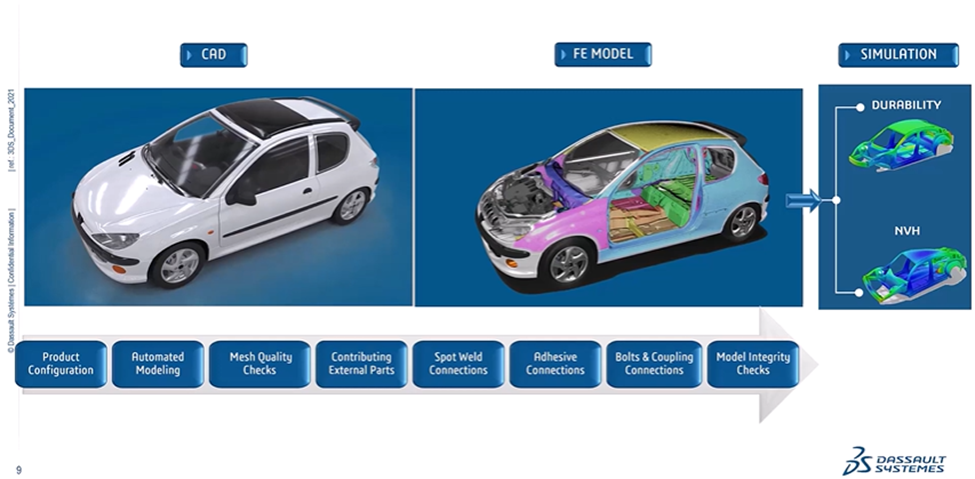
- Product Configuration
- Automated Modeling
- Mesh Quality Verification
- Mesh Generation for Cast/Stamped Parts
- Weld Point Creation
- Weld Connection Definition
- Bolt and Joint Creation
- Full Model Validation
The adoption of the 3DEXPERIENCE platform and MODSIM not only optimizes automotive development processes but also drives innovation in the creation of more sustainable vehicles. By customizing workflows and automating repetitive analyses, design engineers can perform simulations quickly and efficiently—reducing development timelines from several months to just a few weeks.
This approach enables companies to achieve sustainability goals, such as reducing material or energy usage by up to 20%, while maintaining vehicle quality and performance. At the same time, it enhances manufacturing efficiency and improves the overall consumer experience.
The evolving roles of simulation specialists and design engineers, combined with advancements in simulation technologies, have resulted in a more agile and accelerated development process. As a result, companies not only save time and costs but also gain the ability to rapidly implement design changes and optimizations—delivering automotive solutions that meet stringent requirements for quality, safety, performance, and environmental protection.
Related posts
Is Virtual Twin Worth the Investment? Where Does ROI Come From and How Can It Be Measured?
Can AI Replace Design Engineers? The Future of AI in Engineering
How to Shorten Product Development Time: 5 Critical Factors Companies Often Overlook
Modern Product Development: Why Many Manufacturers Still Face Product Launch Delays